
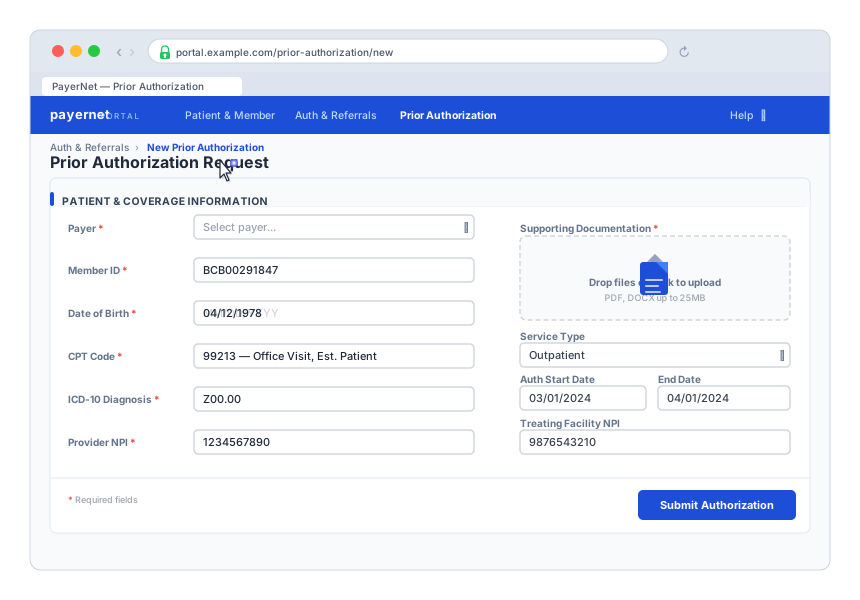
The average physician’s practice spends 14 hours every week on prior authorization. Navigating payer portals, re-entering patient data, uploading clinical documents, checking statuses — over and over.
The work is predictable. It’s repeatable. And until recently, it still required a person at every step, because no automation could reliably handle the complexity. Asteroid’s AI browser agents change that. Prior auth is also one stage of a longer chain: the same portal work continues downstream in medical billing automation. Both halves of the workflow described here now ship as catalogued templates: PA submission with attachments and clinical Q&A and submission and status on the payer’s own portal.
The problem
Prior auth looks simple on paper: submit the right information to the right payer, get a decision. In practice, it’s a highly branching workflow full of edge cases.
Every payer has a different portal — dozens of them — each with its own form structure and MFA flow. Forms change dynamically based on procedure type, place of service, and member plan. Some requests route to third-party reviewers mid-submission. Some CPT codes don’t require auth at all, but you only find that out after logging in.
Every payer is different
Different portals, different forms, different MFA flows. No two submissions are the same.
Dynamic forms
Fields change based on procedure type, place of service, and member plan — mid-submission.
RPA breaks constantly
Traditional scripts are built for the happy path. One unexpected field and someone has to step in.
What AI makes possible
Asteroid’s browser agents handle prior auth the way a trained person would — by understanding the goal, not just following a script.
01
Handles the edge cases
Agents navigate dynamic forms, handle MFA (including TOTP and email-based codes), detect when auth isn’t required and stop early, and recognize when a case needs to route elsewhere. Edge case handling is configured in natural language — describe how you want exceptions handled, and the agent follows those preferences consistently.
02
Gets faster over time
As patterns stabilize, Asteroid compiles optimized execution scripts. Agents get more reliable and faster with every run — not slower as portals shift.
03
Built for a critical process
Prior auth touches PHI at every step. Customers provision their own portal credentials, stored in an encrypted vault. Full execution logs, audit trails, and SOC 2 and HIPAA compliance are standard.
04
Reliable at scale
Asteroid agents are built for production healthcare workflows. They run continuously, handle volume without degradation, and flag exceptions cleanly rather than failing silently.
The full prior auth workflow
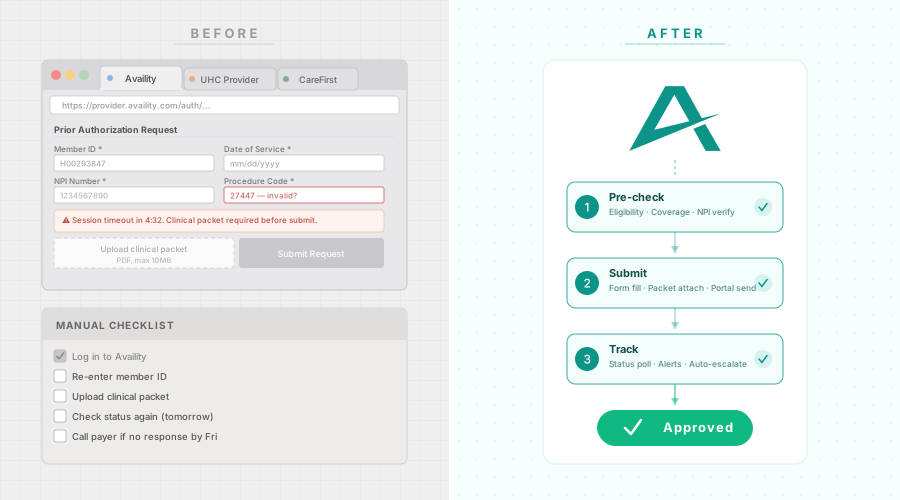
Asteroid covers the complete prior auth lifecycle with purpose-built agents for each stage (the prior authorization workflow library has the full template list):
01
Pre-check
The agent logs into the payer portal, verifies whether auth is required for the given procedure codes and member, and returns a per-code result. No unnecessary submissions.
02
Submission
The agent handles the full form: payer selection, CPT codes, provider NPI, patient demographics, diagnosis codes, service dates, document upload, and final submission. Output is structured data — not a screenshot.
03
Status tracking
Agents check batches of pending authorizations on a schedule, returning normalized statuses (Approved, Denied, Pending, Partially Approved) via webhook into your existing system.
Why teams use Asteroid for prior auth
Any portal
Browser agents work at the UI level. If a human can log in and use it, the agent can too. No API required.
Natural language
Exception handling, routing logic, and edge case preferences are set in plain English. No engineering work to adjust behavior.
Infinite scale
The same agent that handles 20 submissions handles 2,000. Volume goes up, staffing costs don’t.